


Phil Tippett Has Been Extinct Before
Scroll
Article by Morgan Myer
The stop-motion legend behind Star Wars, RoboCop, and Jurassic Park on the CG revolution that nearly broke him, why AI still needs a director, and the Ray Bradbury advice he’s taken as gospel for 50 years.
I grew up on Lucasfilm. The movies Tippett’s hands touched (Star Wars, RoboCop, Jurassic Park) are the ones that made me want to make things, and 15 years into running my own small production studio, they still shape how I think about the work. So when he agreed to talk with me about how tech is changing filmmaking, I felt like a kid again.
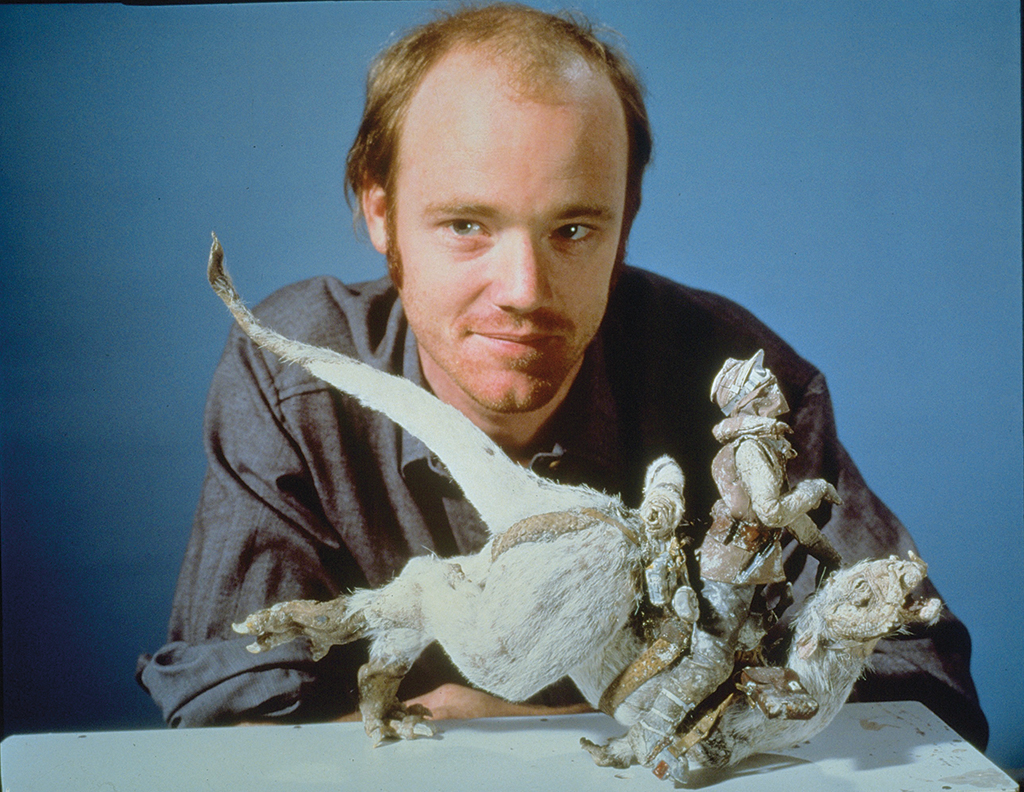
What made me reach out is a story from the early ’90s. Tippett, by then the industry’s leading stop-motion animator, had been hired to bring Steven Spielberg’s dinosaurs to life with a system his team called Go Motion. Then, in preproduction, the computer-generated tests came in. His reaction, as the legend goes: I guess I’m extinct. Spielberg liked the line enough to put a version of it in the movie. Tippett stayed on as dinosaur supervisor, got a room full of computer animators out of their chairs to learn how a raptor carries its weight, and went home with an Oscar.
Thirty-odd years later, plenty of people in my industry feel the way he felt. So I asked him what it took to come out the other side, and what he makes of the newest machine at the door. He has opinions. He also describes himself, cheerfully, as “totally misanthropic.”
This conversation has been edited and condensed for clarity.
Morgan Myer: Walk me through those early years. Was it stop motion from the start?
Phil Tippett: I did what I could afford. Drawing, getting clay and sculpting, and then eventually mowing enough lawns to buy an 8mm camera. I was probably in my early teens when I started experimenting with stop motion.
MM: How did you get from there to the movies?
PT: I had some very important mentors who were encouraging. I had a correspondence with Ray Bradbury, and there was a guy who lived near me, Bill Stromberg, who was making 16mm short films with stop motion. Together we connected with a commercial house in Hollywood
called Cascade Pictures of California, got to know the people there, and ended up getting hired. I worked for them for a number of years. Then that group of people got hired by George Lucas to make Star Wars, and it all kind of took off.
MM: Is it fair to say that by Jurassic Park, you were one of the preeminent stop-motion artists in the world?
PT: The last one.
MM: And at the start, stop motion was the plan for bringing the dinosaurs to life.
PT: By that time we’d developed a system we jokingly called Go Motion. It was quite complicated and required a lot of technology and engineering. The characters were essentially computerized rod puppets. The performances were done one frame at a time and then played back, so the shutter on the camera would open while the puppet was actually moving, and you’d get motion blur. The B-movies of Ray Harryhausen’s time had turned into the movies of the Star Wars generation, and you needed that bump to integrate the characters more convincingly into the shots.
MM: I remember seeing footage of you and your team doing what looked like a dance class, trying to figure out how velociraptors moved.
PT: A little bit. I was trying to get the CG animators out of their chairs. In stop motion, we would typically act out the characters the best we could, take timings with stopwatches, and break down the choreography to the second.
MM: And then the technology changed underneath you halfway through the movie.
PT: No, no, no. It was very early on, in preproduction.
MM: Is it true you said something like, “Well, I guess I’m extinct”?
PT: It’s all true. I was really kind of devastated by it.
MM: That must have been a hard period of your life.
PT: I overreacted emotionally, because I saw everything I had worked for and really loved evaporate. But on Jurassic there was a transition, because the skill level of the computer graphics animators wasn’t quite up to what it needed to be. The technology needed a different point of view. The software fed back charts and graphs that gave you an indication of how things were moving, and you can’t look at charts and graphs. You actually have to physically manipulate something, because when you do that, you get things you can’t imagine. You just have to feel them. To that degree, the art and craft combine.
MM: That feeling is what I keep coming back to. Feeling the physics of the world around you, the emotions of people and things. AI isn’t observing any of that. Whether it’s a CG dinosaur or anything else, somebody still has to look at it and decide what feels right.
PT: Marcel Duchamp said art is what makes us human. That’s the thing. You can look at history, and that’s what humans do. It’s philosophical. It’s imaginative. It’s a whole bucket of wax.
MM: You said you overreacted during Jurassic. I think a lot of my peers are going through exactly that right now.
PT: I wasn’t overemotional. It was actually that feeling. It was real. Drowning.
MM: But you came out the other side. These days you’re a director, a consultant, a visual effects supervisor.
PT: More and more, particularly now that things have moved over to AI. As we’re developing and researching what it can give us, my hat is more of a writer-director.
MM: Isn’t overreacting just part of who we are? When talkies came in, people said, “I can’t do this. I don’t want any part of it.” Then the technology caught up, people adapted, and suddenly writers could build characters through dialogue.
PT: You can look at it two ways. Technology was a huge boon, but then it gets co-opted by money, and that always gets in the way. Most studios, and Stanley Kubrick too, build their stories around books that have already been written. Kubrick used music that had already been composed; he’d just try to find the best stuff. Hollywood’s been doing that forever. And in some ways, when sound came in, it trashed the silent era, where there were a lot of creative things going on. There’s a lot you can do without a bunch of blabbing. But if you want to mount a complicated narrative that people can understand, there’s got to be a great deal of exposition. When it’s handled right, it’s amazing. For the most part, though… I don’t know how many cable channels I’ve got, and I can’t watch anything. Talk about AI slop, for heaven’s sake.
MM: But the slop comes from people without any discernment.
PT: There are competent filmmakers out there making one police procedural after the next. Competent. But why? It’s just to create product.
MM: So how are you feeling? Optimistic? Worried? Like this is just another phase?
PT: It’s really hard to tell where the world’s going right now, and what public sentiment is going to be. I’m appalled by vertical formatting. I can’t believe that’s acceptable. It’s such a horrible format. And people seem to like it. So what do you do about that? Nothing.
What I say about AI is that it’s like having a dog. It trains you as much as you train it. It’s the same with technology in general. You don’t realize you’re being taken over by it, with the amount of time people spend on their devices being entertained. We’re being trained whether we know it or not.
MM: Are you training it on the work you’ve built? Are you okay with that, or is it a real conundrum?
PT: To me it’s like: What is this new thing? How does it work? You’ve got to get under the hood and mess around with it before you even have the right to talk about it.
MM: Do you still get your hands dirty? Sketching, early iteration?
PT: To a degree. We’re making the transition from digital and analog to AI, so more and more it has to go into the hands of people who know more than I do. If I can’t touch something with my hands, it’s off the table. I can do certain things, like photographing three-dimensional characters to train the AI. Then I leave the actual work to the brainiacs. It tends to work out pretty well, because what I’m trying to do is take all the things that don’t work in AI and run them through a cinematic filter, so you can make AI look like what cinema looks like, and not what AI wants to give you.
MM: So all those years of observation have turned into this supervisory role, being able to shape the stuff. We’re going to need way more of that.
PT: It’s essential. People will buy any kind of shit these days. But if you’re able to cross that divide and make something that has a wow factor, you can get people’s eyes on it. The objective always is to draw people in and create the same sense of wonder and magic that I experienced when I was a kid.
MM: Part of why I’m writing this is that our industry keeps telling us to adapt and adopt. I want to double down on human intervention as the thing that ultimately moves people.
PT: That’s the only thing that will create art out of it. Its backbone is craftsmanship, and figuring out how to use the new tools takes time and perseverance. It’s not better, faster, cheaper. Everything I’m doing is kind of against the tide of that. It’s much more craftsmanlike.
For the kind of experiments we’re doing, it’s more writing, directing, maybe drawing some storyboards. The last thing I want to do is draw storyboards to train AI on. I want to see a set. I want to be able to move around it, put characters in it and place them, and make up my mind. I’m making decisions, and not having AI make it up for me.
MM: Why is that so important to you?
PT: I have to know what I’m doing. It can’t be hidden in a black box. Digital was bad enough, until you could actually get your hands on something rendered. I don’t know how you can deal with anything pictorially, performance-wise, or dramatically until you see what you’ve got. Then you can say that needs to shift left or right, or the gaze needs to be more pensive. It’s like old filmmaking. You just need to work it. The experiments I’m doing are taking a very long time. At least the way I’d like to imagine it, this stuff is not at all ready for prime-time filmmaking. It will be.
MM: Does faster iteration excite you at all?
PT: I remember some of my grandfather’s tools. The tools available today are far superior, and I wouldn’t necessarily want to go back. But if I didn’t have anything else, my grandfather’s hammer certainly works.
MM: You took advice from some really important people early in your career. Do you try to play that forward?
PT: Some of the best advice I ever got was when I wanted to be a stop-motion animator. Ray Harryhausen was the only guy in the world doing it, and there was no evident possibility of being able to make a living at it. Ray Bradbury’s sermon was: Do what you love. Because if you do what you love, even if you fail, you’ll be in a far better place than if you never tried. I took that mantra when I was getting a lot of blowback from relatives and whatnot. That was kind of my flag.
MM: So patience is the saving grace?
PT: Oh, no. There’s no guarantee. I have been very, very lucky so far.